Case Study: Multiple Fatalities at the 1961 Italian Grand Prix
On September 10, 1961, during the Italian Grand Prix at Monza, a collision between two Formula 1 cars on the second lap resulted in 16 fatalities.
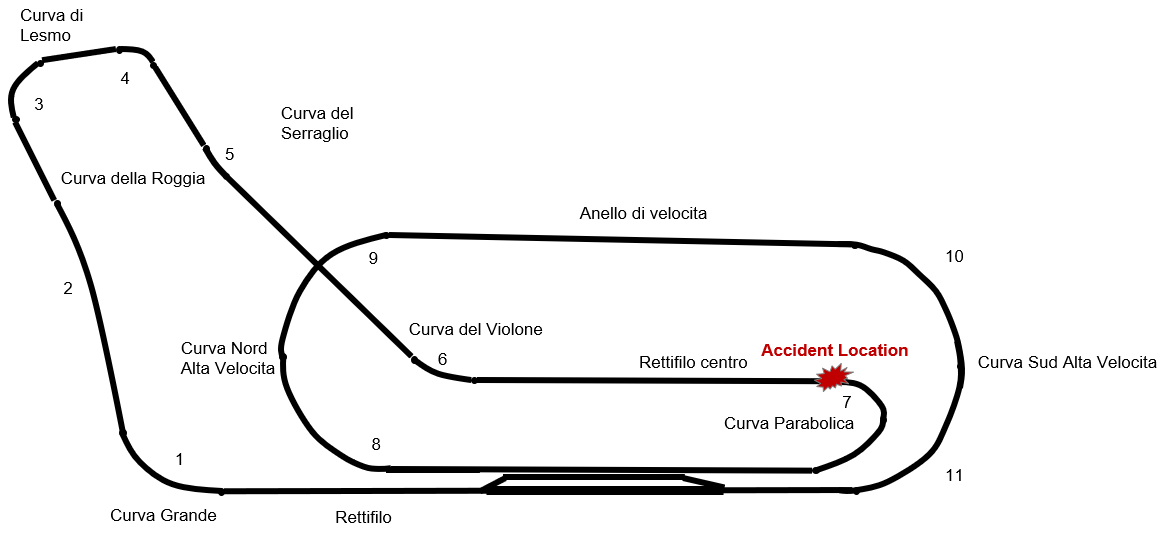
Wolfgang von Trips, driving a Ferrari, and Jim Clark, driving a Lotus, made contact near the Parabolica corner. Von Trips' car became airborne, left the circuit, and entered a spectator area along the track boundary at turn 7 (Curva Parabolica). Von Trips was thrown from the car and died. Fifteen spectators were killed and more than 20 were injured. Clark was not seriously hurt. The race continued and was won by Phil Hill.
1961 Italian Grand Prix Track Diagram
Facts:
-
Contact occurred between the two cars on lap 2 near the Parabolica corner
-
Von Trips' Ferrari became airborne following the contact
-
The car traveled into the spectator area beyond the track boundary
-
Von Trips was ejected from the cockpit
-
15 spectators were killed and over 20 were injured
-
Spectator separation from the racing surface was minimal
-
No spectator barrier standard was in place at the time
-
Von Trips was not wearing a seatbelt
-
Seatbelts were not mandatory in 1961
What Happened in The 1961 Italian Grand Prix at Monza?
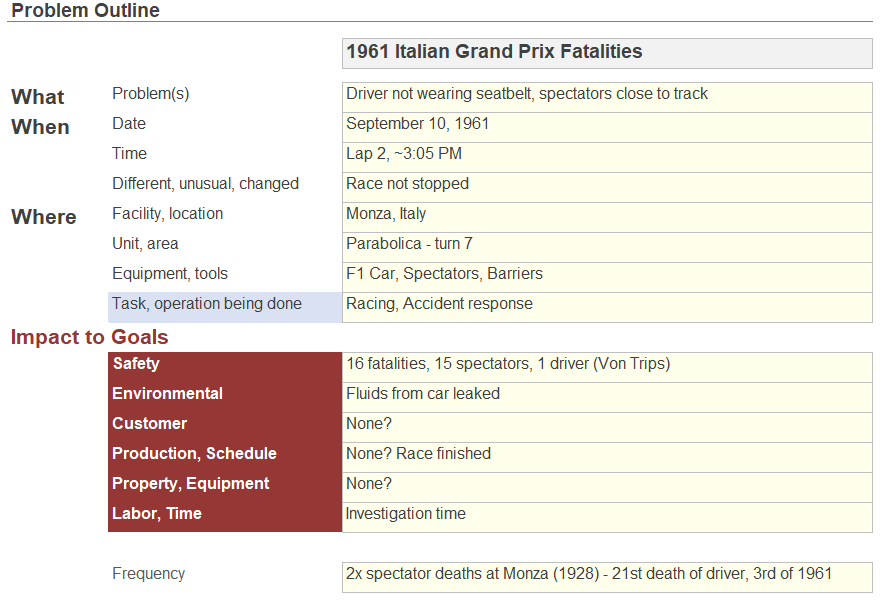
The Cause Mapping® approach begins with a Problem Outline — a structured summary that captures what happened, when and where it happened, and the impact to the organization’s goals. The Problem Outline describes the specifics consequences of the incident, which provides the starting point for cause-and-effect analysis.
The 1961 Italian Grand Prix incident resulted in 16 fatalities: a catastrophic impact to the Safety goal. The analysis builds backwards from that effect to reveal all the factors that contributed to it.
The last field in the Problem Outline is Frequency, which provides additional context for this type of incident. In this case, there was a prior spectator fatality at Monza in 1928. Von Trips was the 21st Formula 1 driver to die while participating in the sport, and the third of the 1961 season.
1961 Italian Grand Prix Fatalities Problem Outline
Why Were There Multiple Fatalities During The Race?
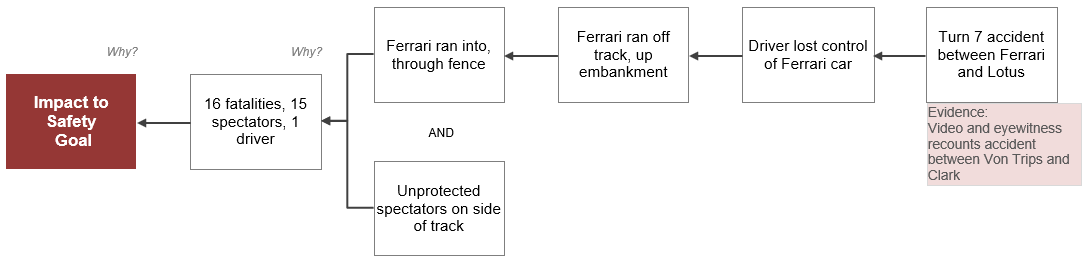
A 5-Why Cause Map™ is simple way to start the analysis and establish a basic understanding of the incident. Each step builds backward from the observed outcome.
The 5-Why below is accurate, but it only represents a partial explanation of the causes that produced the incident. Film footage and eyewitness accounts confirm the sequence of events, including the contact between the two cars. The precise mechanics of how that contact occurred are less clearly established in the historical record, so the analysis does not assign fault to either driver.
1961 Italian Grand Prix Fatalities 5-Why Cause Map

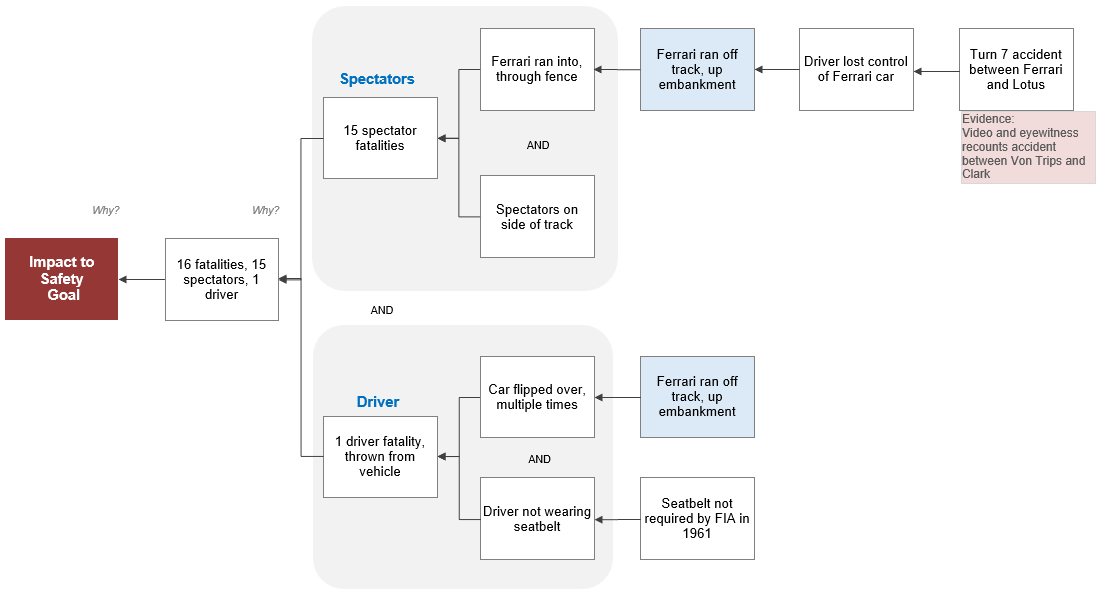
As the Cause Map™ expands, it reveals different causal paths. Systematically working backward through an incident uncovers the causes that were necessary to produce this exact outcome.
The spectator fatalities occurred because the Ferrari left the circuit AND spectators were in the path of the car without protection. Both conditions were required to produce the outcome, so changing either one of these paths could have changed the outcome.
1961 Italian Grand Prix Fatalities 6-Why Cause Map
Now, we’ll continue expanding the analysis. The 16 fatalities can be separated into 15 spectators and one driver. This reveals separate causal paths, which in turn reveal additional solution opportunities.
1961 Italian Grand Prix Fatalities 12-Why Cause Map
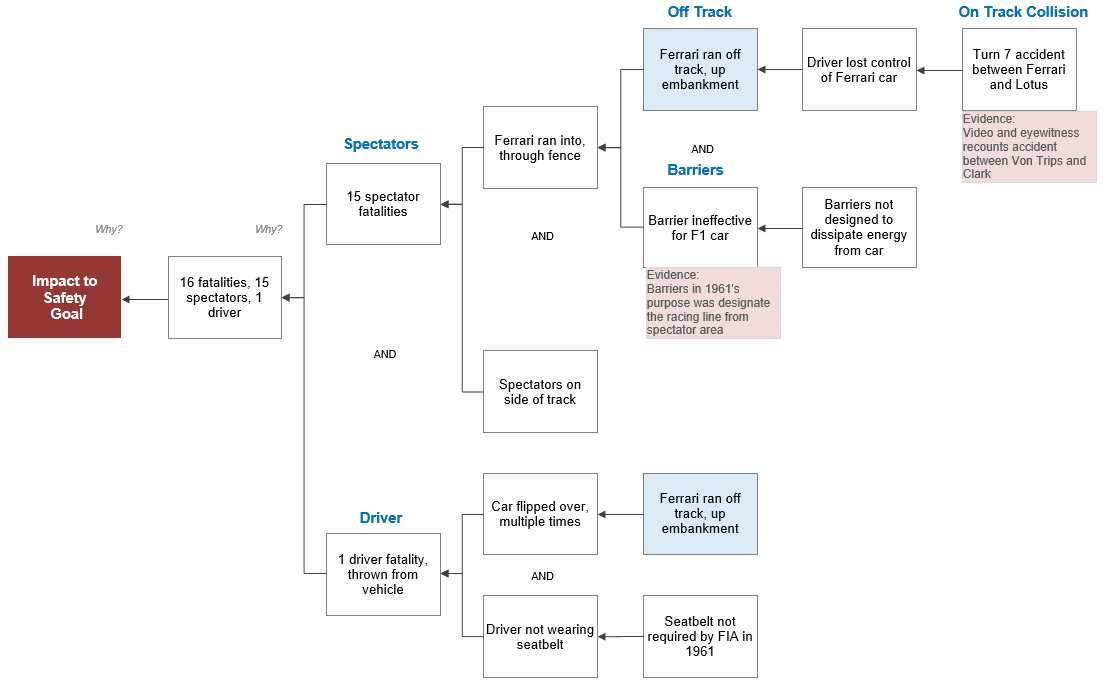
The spectator path shows the car leaving the track AND the presence of spectators at that same location. There was a “barrier” at that section of the circuit, but it was not designed to dissipate the energy of an airborne car at racing speed. The barrier was designed to keep spectators away from the racing surface, and it performed that function. Modern spectator barriers are designed to do more, including managing the energy of a car hitting or leaving the track. The design spec for spectator barriers has, thankfully, changed.
The driver path shows how von Trips was thrown from the car after it ran off the embankment. The cause of the car flipping — running off the track and up the embankment, shown in a blue cause box — is the same cause as the Ferrari being at the same location as the spectators.
The car flipping is not the only cause of the Von Trips being thrown from the vehicle. He was also not wearing a seatbelt. Surprisingly, seatbelts were not required by F1 in 1961. Not wearing a seatbelt was standard practice among drivers at that time, rather than an individual deviation from procedure.
1961 Italian Grand Prix Fatalities 14-Why Cause Map
How Could Similar F1 Crashes Be Prevented?
Because multiple causes were required to produce this incident, there are multiple places where the outcome could have been changed. Solutions on any one path would have changed the outcome independently of the others. Focusing on a single “root cause” not only obscures this point, it also unnecessarily restricts the solution set.
At the time of the incident, there was no carbon-fiber survival cell, no HANS device, no halo, and no crash-testing standard equivalent to what exists today. In 1961, protection for Formula 1 drivers was largely limited to a helmet and a roll bar.
Modern Formula 1 addresses the problem differently, and the solutions are tied directly to the causes identified in the analysis.
|
Formula 1 Safety Solutions |
Causes |
|
Have spectators stand back from track |
Spectators in direct proximity of track |
|
Runoff areas to dissipate energy before car exits track |
Limited distance between track and spectator area |
|
Barriers able to dissipate energy from cars traveling at speed |
Barrier not designed to dissipate energy of cars traveling at racing speed |
|
Racing harnesses |
Driver not restrained in vehicle |
|
Survivor cell design |
Driver exposed to forces from crash |
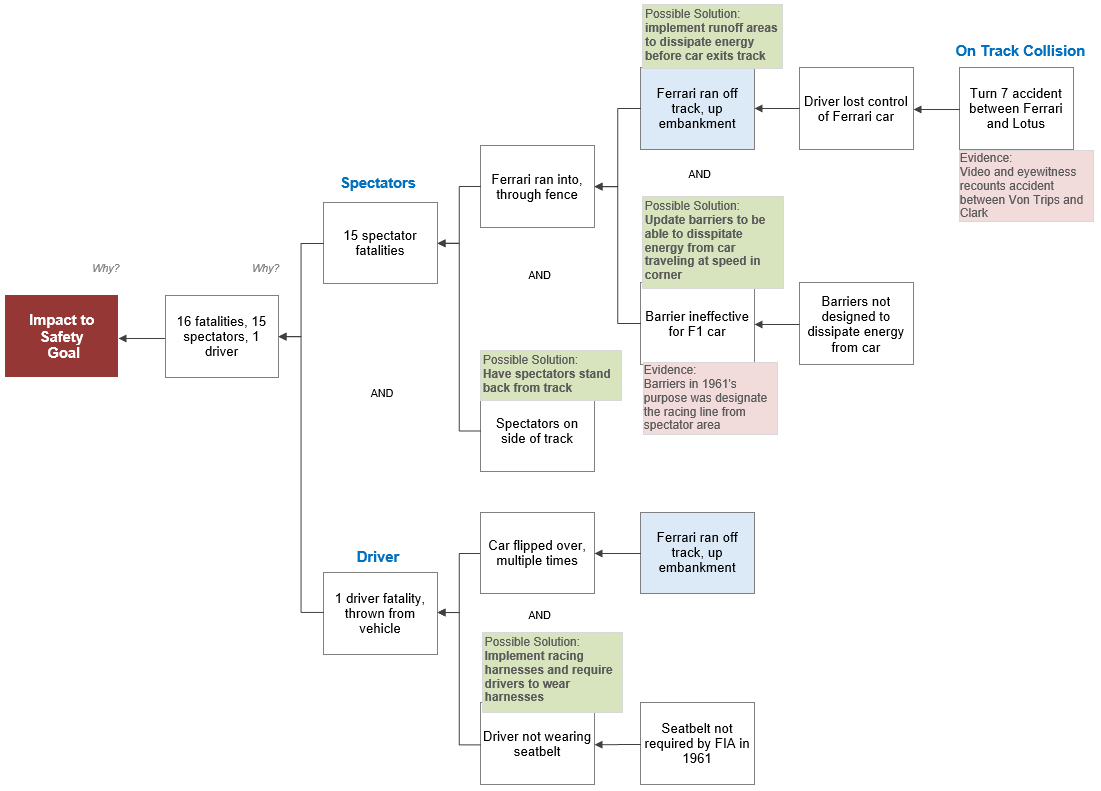
The goal is to have a safety system in place that actually controls the hazard. Each solution shown in the table above traces to a specific cause on the Cause Map below.
1961 Italian Grand Prix Fatalities 14-Why Cause Map with Solutions
The evolution is more than better barriers and better equipment. It reflects a change in the questions being asked.
In 1961, the question was: How do we keep cars and people separated?
Today, the questions goes further: What happens if the car leaves the track? How do we control every step that follows?
Asking “What could go badly?” is fundamental to how organizations manage risk today with proactive approaches such as FMEA, PHA, HAZOP, JSA, and Hazard Recognition. Each of these approaches is based on the principle of cause and effect. What could cause this negative effect in the future? Which specific causes are we going to control to prevent that effect?
Being proactive is the preferred mode, but it is also important to be good at reactive problem solving. After an incident, it’s important to clearly understand exactly how each proposed corrective action controls a specific cause identified in the analysis. Connecting each solution to a specific cause helps avoid broad action items like “retrain” and “update procedure.”
The same approach of breaking the incident into its causes works the same for this 1961 case study as it does for incidents today. Fundamental principles of explaining how and why things happen don’t change.
In the comments, let us know if this is similar or different from the way your organization manages risk.

Note: This analysis is based on publicly available historical records including contemporary race reports, Autosport and Motorsport magazine archives, FIA historical and safety regulation development records, and photographic and film evidence from the 1961 Italian Grand Prix. No formal investigation report equivalent to modern standards was produced at the time. Causal relationships that cannot be directly confirmed by the available evidence are marked as possible.