
The day before I was presenting at a hotel, I went into the meeting room to check the setup. One thing I always look at is the lighting around the screen. You want enough light in the room for people to see, but you don’t want lights shining directly on the screen and washing out the image.
In this room, there were can lights directly above the screen. The switches were all the way on or off, with no dimmer and no separate control for different lights. I brought this up to the hotel manager who was in the room, and from his point of view there was no practical solution. That’s not how the lights for that room were configured.
I kept asking about the lights, and I could tell the manager was starting to get annoyed. I again asked, “Is it possible to only turn off the two above the screen and leave the rest on?” He said “no.” I then asked if anyone from maintenance was available. The manager was now even more annoyed, but he called for a technician.
A few minutes later, a maintenance guy walked in, and I asked the same question. Without hesitation, the maintenance technician said “No problem. I can unscrew those two bulbs.” The maintenance technician looked at the same problem and saw it differently. To the technician, the solution was simple and obvious, but to the manager, it was impossible.
The Value of Different Perspectives
People in your organization have different areas of expertise, different experiences and different understandings of how things work. They literally see problems differently. An electrician and mechanic, or a nurse and an anesthesiologist, can look at the same incident and notice different things. A manager and someone working on the frontline can confront the same situation and see different ways to affect it.
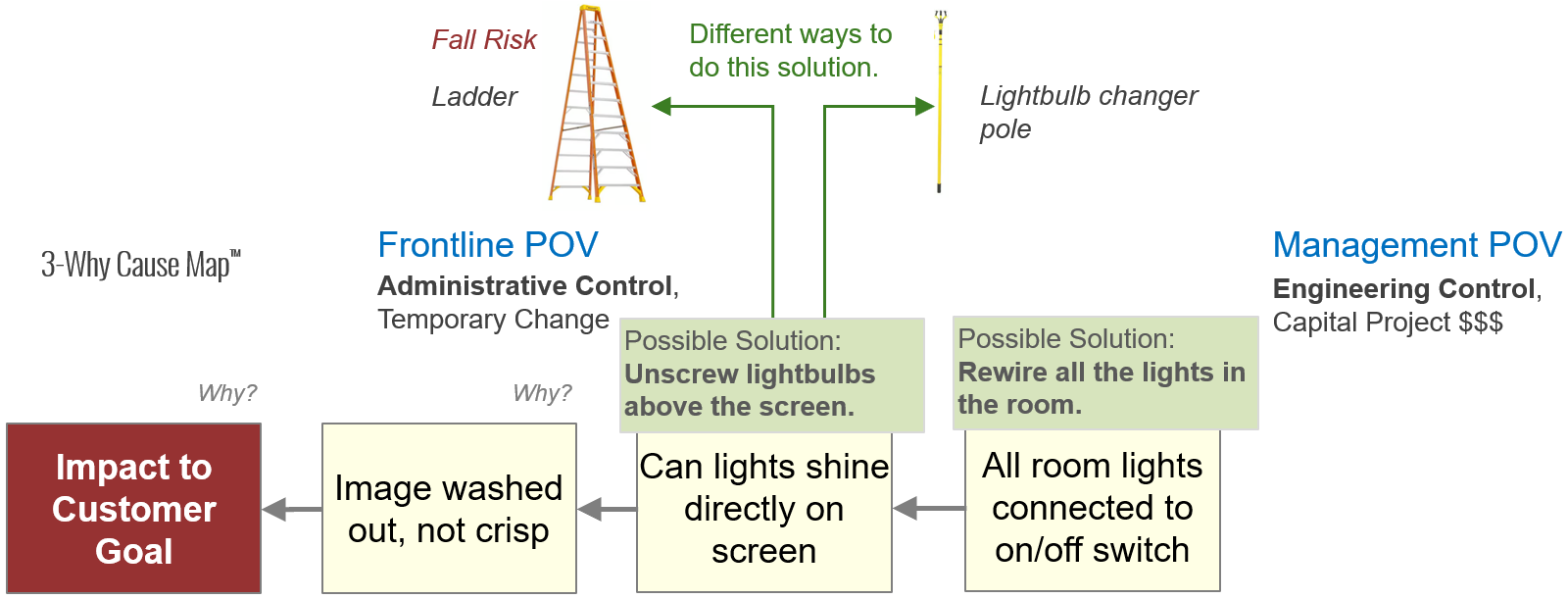
In the hotel room, the manager saw the lighting through the switches: on or off. Changing the lights meant a major electrical project to rewire the room.
The maintenance guy saw a much simpler solution.
Both solutions address the same problem, but the cost, time and effort are completely different. What looks too expensive, impractical or impossible to one person may be simple and inexpensive to someone else. The point isn’t that frontline employees always have better solutions—it’s that you don’t know what ideas everyone has. When you get to solutions, ask people for their ideas: frontline, technical leads, and management. Linus Pauling said, “The best way to get a good idea is to have a lot of ideas.” You can apply this thinking in your organization by breaking a problem into parts, then asking people what they would change.
Even for the solution “Unscrew lightbulbs,” there are different ways to implement it. The details matter. With that high ceiling, removing the bulbs may require a tall ladder, which introduces a fall risk. The maintenance guy at this hotel had a lightbulb-changing pole, so he didn’t need a ladder.
A small change in how a solution is implemented can reduce risk while still producing the desired outcome. It’s a good reminder that small changes can produce significant results.
Room Lights 3-Why Cause Map™ Diagram
Accessing the Know-How in Your Organization
At ThinkReliability, our Cause Mapping® problem-solving approach has three basic steps: problem, analysis and solutions. The causes in the analysis provide options where changes can be made.
Note the plurals: causes, options, changes. An incident requires multiple causes, and each one creates another place to consider a change. The more thoroughly you explain the incident, the more solution opportunities you can see. The difference between a great solution and a mediocre one can be subtle. Focusing on a single “root cause” unnecessarily limits that set of options.
Even for a single cause, there may be multiple ways to make a change. In the hotel room, the manager saw rewiring as the only way to change the lighting. The maintenance guy saw that the same result could be achieved by simply unscrewing the bulbs above the screen.
A thorough analysis gives people across the organization a shared explanation of what happened. From there, they can bring their own experience and expertise to identify solution options.
The incident is the same. The causes are the same. What changes is how many solutions your organization can see.